Velocity Banking Step-by-Step: How the HELOC Strategy Works
A simple step-by-step look at how people use a HELOC or PLOC to cut mortgage interest and pay off a home faster.
Introduction
Most people think a 30-year mortgage is simple: borrow money, make payments, and slowly pay it off. What many people miss is how much of the early payment goes to interest.
Velocity banking uses a simple-interest line of credit, like a HELOC or PLOC, to change how your cash flow works against the loan. You can often start without refinancing.
This guide explains the mortgage problem, shows a real example, and walks through the strategy step by step. For the shorter plain-English version, download The Honest Homeowner's Guide to Velocity Banking.
Velocity Banking Step by Step — Quick Summary
- Open a line of credit (HELOC or PLOC)
- Use the line of credit to make a bigger payment on the mortgage
- Route your income into the line of credit
- Pay monthly expenses from the line of credit
- Use your monthly surplus to pay the line back down
- Repeat the cycle to steadily reduce the mortgage balance
The Mortgage Interest Problem
A standard mortgage uses amortized interest. That means a lot of your early payment goes to interest first and much less goes to principal.
In the first year of a 30-year loan, about 80% of each payment may go to interest. Even halfway through the loan, you may still owe much more than you expect.
That is why a 4% or 5% mortgage can still cost far more than it looks like on paper. One number to check is the Total Interest Percentage (TIP) on your closing documents.
~80%
Of Year 1 payments that go to interest~60%
Principal still owed at year 15 of a 30-year loanDaily
How often mortgage interest actually accruesWhat That Looks Like on a Real Loan
When I bought my home, I did not pay much attention to the TIP disclosure until someone pointed me to it.
The loan was $230,000 at 4.375%. The rate sounded fine. But the TIP was 79.923%. That meant I was on track to pay almost 80% of the original loan amount again in interest. On a $230K loan, that is about $184,000 in interest.
That number does not show up on your monthly statement, so it is easy to miss.
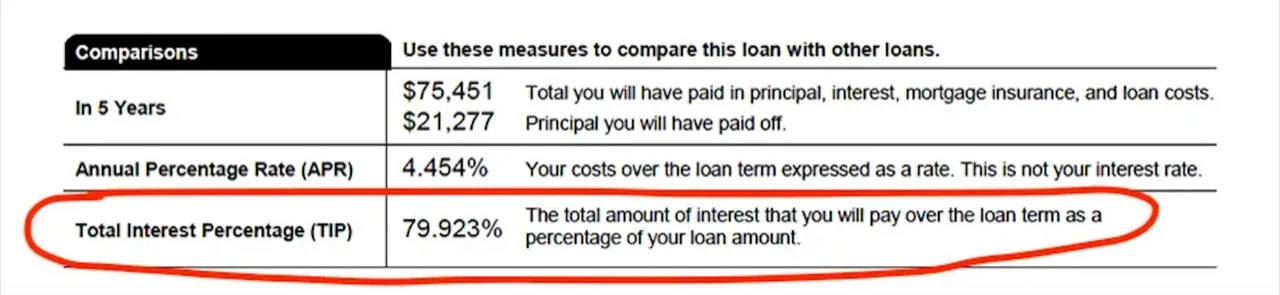
Actual closing document — 4.375% rate, TIP 79.923%
When I first experimented with this approach, I used a personal line of credit from a credit union at 11.8%, not a HELOC. Even at that rate, the math still worked because of how amortized mortgage interest is structured. The velocity banking strategy doesn't live or die by the LOC rate alone — it depends on how quickly the amortized interest is being displaced.
Not everyone will have the same result. But the point isn't that PLOC rates are low — it's that the comparison between an amortized mortgage and a daily simple-interest LOC isn't as simple as looking at the rate on each. A velocity banking example with a HELOC will look different from one using a PLOC, but the core mechanics are identical.
Pull out your loan documents and look for the TIP. CFPB explains that TIP appears on page 3 of the Loan Estimate or page 5 of the Closing Disclosure. That number — not the interest rate alone — helps show what you are agreeing to pay over the life of the loan.
What Is Velocity Banking?
Velocity banking uses a revolving line of credit, usually a HELOC or PLOC, to help lower a mortgage faster. In a 2nd-lien setup, this often starts with chunking the mortgage.
You route income through the line of credit and make bigger principal payments from time to time. That can reduce the mortgage balance faster and cut future interest.
Instead of letting your paycheck sit in checking, you let it lower the balance on a daily simple-interest line of credit first.
The idea is not to earn more money. The idea is to make your current cash flow work harder. If you do not have enough home equity for a HELOC, some people start with a PLOC instead.
The Core Idea
The strategy works by moving debt from one interest structure to another. Understanding the difference is the whole game.
Traditional Mortgage
Amortized Interest
- Interest calculated for the full 30 years up front, then front-loaded into early payments
- In year one, ~70-80% of each payment goes to interest — the principal barely moves
- Extra payments reduce the balance, but that equity is locked in — you can't access it without a new loan
- Monthly payment timing vs. daily interest accrual creates a compounding gap
HELOC / PLOC
Daily Simple Interest
- Interest accrues each day based only on the current outstanding balance
- Lower the balance, and you lower tomorrow's interest — immediately, no schedule
- Every paycheck deposited cuts the balance — and therefore cuts daily interest — the moment it lands
- The line of credit stays accessible — funds remain liquid if you need them
Velocity Banking Step-by-Step
The strategy runs in repeating cycles. Here's how each cycle works for one of the common approaches — a 2nd-lien HELOC or PLOC alongside an existing mortgage.
Step 1
Open a HELOC or PLOC
Get approved for a HELOC (requires home equity, typically 20%+ remaining) or a PLOC from a bank or credit union. Confirm it uses true daily simple interest. A limit of $10,000–$30,000 is enough to start.
Step 2
Make a Lump-sum Mortgage Payment (to principal)
Draw from your LOC and apply the full amount as a lump-sum principal payment on your mortgage. A typical chunk is $5,000–$20,000. It instantly moves that balance from amortized to simple-interest territory.
Step 3
Deposit Your Income into the Line
Route your income directly into the LOC instead of a checking account. Each deposit immediately lowers the balance — and since interest accrues daily, every day your income sits there, it's cutting interest.
Step 4
Pay Monthly Expenses from the Line
All normal monthly expenses come out of the LOC. The balance rises when you spend and falls when your paycheck arrives. As long as you spend less than you earn, the net monthly trend is down.
Step 5
Pay Down the Line With Your Surplus
Your monthly surplus (income minus expenses) pays the LOC back over time. A $500/month surplus with a $10,000 chunk takes roughly 20 months. A $1,500 surplus cuts that to about 7 months.
Step 6
Repeat the Cycle
Once the LOC is paid back down, chunk the mortgage again. Each cycle drops your principal further. Over multiple cycles, the mortgage balance falls noticeably faster than it would with standard payments alone.
A Simple Example
Not a precise projection — but enough to show the mechanics clearly.
The Situation
$280,000
Mortgage balance at 6.5%27 years
Remaining on the loan~$1,750/mo
Standard mortgage payment$6,000/mo
Monthly take-home income$3,500/mo
Monthly expenses (excl. mortgage)~$750/mo
Monthly cash-flow surplusHELOC available: $20,000 at 8.5% variable
Draw $15,000 from the HELOC and apply it as a lump-sum principal payment. The mortgage balance drops from $280,000 to $265,000.
Each month, the $6,000 paycheck lands in the HELOC first — temporarily dropping the balance to ~$9,000. As bills come out, it climbs back, but averages roughly $12,000 over the month. Interest is calculated on that average daily balance, not the full $15,000.
The $750 monthly surplus chips the LOC down. After about 20 months, the HELOC is back near zero and ready to chunk again.
Chunk again — another $15,000 onto the mortgage, now around $252,000 after regular payments. The same process repeats.
Each cycle, the mortgage balance is lower. The standard payment you're still making targets a smaller principal with less amortized interest going forward — the two effects compound.
Depending on spending discipline and chunk frequency, this approach can realistically cut 5–10+ years off a 30-year mortgage.
Reality check: This assumes consistent cash flow and spending discipline. Life happens — the strategy still works when you occasionally miss a month, you just make up ground more slowly. The model breaks down if you habitually overspend on the LOC.
Why People Use This Strategy
Refinancing is Not Required
If you locked in a 3% mortgage rate in 2020 or 2021, and hate the idea of refinancing, velocity banking lets you keep the mortgage and use the "chunking" strategy. 1st lien HELOCs are an option if the math supports refinancing, though and leaves your equity more liquid in case of a life event.
Maintains Liquidity
Extra mortgage payments lock equity into the walls — inaccessible without a new loan. A HELOC keeps cash accessible. If you deposit $10,000 and need $5,000 back for an emergency, you can draw it. You accelerate payoff without losing financial flexibility.
Exploits Daily Simple Interest
Your paycheck sitting in a checking account does nothing to reduce mortgage interest. Routed through a daily simple-interest LOC, every dollar works the moment it lands — even if it's only there for a few days before bills go out.
Works Without Higher Income
The strategy is built on your existing monthly surplus — the gap between income and expenses. Even a modest $500/month surplus produces results. It's about efficiency, not earning more.
When It Might Not Work Well
Velocity banking isn't the right fit for everyone. Here's when to think twice.
Negative or Near-Zero Cash Flow
The strategy depends on income exceeding expenses. If your monthly surplus is very small or nonexistent, the LOC pays back slowly or not at all. Running a deficit means you're borrowing at a higher rate than you're saving on the mortgage. There are some situations where cashflow can be immediately improved however.
You're Late in Your Mortgage
Amortization is most front-loaded in the early years. If you're 25 years into a 30-year loan, most payments already go to principal anyway. Velocity banking provides the most advantage when the mortgage is younger and interest is still dominant.
You Don't Qualify for a HELOC
HELOCs require home equity — typically 20% or more remaining after the draw. If you're underwater or have minimal equity, a HELOC isn't available. A PLOC from a bank or credit union may be an option, though limits are usually smaller.
Common Misconceptions
"I can just compare the rates."
A 6.5% mortgage and an 8.5% HELOC sound like the HELOC costs more. But amortized and simple-interest loans aren't directly comparable with a rate-to-rate check. The total interest paid depends on how quickly you reduce the principal and how interest is calculated each day. Your loan's TIP (Total Interest Percentage) helps tell the fuller story.
"Making extra payments does the same thing."
Extra principal payments do reduce your balance — but that equity gets locked in. You can't access it without refinancing or getting another loan. A HELOC lets you make large lump-sum payments and retain access to that capital if you need it. Same payoff acceleration, more financial flexibility.
"The HELOC rate is variable — too risky."
Variable rates are a real consideration, but the risk is manageable. Model different rate scenarios before committing, and aggressively pay the LOC back each cycle. The longer you hold a balance on a variable-rate LOC, the more rate exposure you carry. Fast payback shrinks that window significantly.
"This only works for high earners."
The strategy works based on your monthly surplus — the gap between income and expenses — not your income level. A household making $60,000/year with $1,200 in monthly surplus can use velocity banking. It just runs more slowly than a household with $3,000 in monthly surplus.
"This is new or unproven."
The underlying mechanics — daily simple interest, principal reduction, revolving credit — are standard financial tools. Velocity banking applies them in a structured way. The math is verifiable. What varies is execution quality and product selection: not all HELOCs and PLOCs calculate interest the same way.
The Math Works Differently for Everyone
Your results depend on your balance, rate, monthly surplus, and which product you qualify for. The only way to know if this makes sense is to run your actual numbers.
- They'll tell you honestly if it works for your situation
- No obligation — watch the free video first if you prefer
- Free consultation, not a sales pitch
Affiliate disclosure: I may earn a commission if you enroll with RYU — at no extra cost to you.
What the free session covers
-
Your numbers modeled
Income, expenses, equity, and current rate -
Which path fits your situation
2nd-lien HELOC, 1st-lien HELOC, or PLOC -
Realistic payoff timeline
Based on your actual cash flow, not a generic example -
Honest assessment
They'll tell you if it doesn't fit your situation
Common Questions About Velocity Banking
Answers to what people ask most about velocity banking and the HELOC/PLOC strategy.
Does velocity banking actually work, or is it a scam?
The math behind velocity banking is real and verifiable. It's based on two well-established financial concepts: daily simple interest and principal reduction. The strategy is not a scam — but it requires genuine cash-flow discipline to work. People who use it successfully track their spending carefully and consistently pay down the LOC each cycle. People who treat the LOC as spending power tend to make their situation worse.
How much of a cash-flow surplus do I need for velocity banking to make sense?
There's no hard minimum, but a monthly surplus of $500 or more is generally where the strategy starts to produce meaningful results. With $500/month and a $10,000 chunk, it takes roughly 20 months to repay the LOC. A $1,500 surplus cuts that to about 7 months. The higher your surplus, the faster each cycle completes.
What's the difference between velocity banking and just making extra principal payments?
Extra principal payments reduce your mortgage balance — but that money is locked in. If you need it later, you'd have to refinance or get a home equity loan. Velocity banking uses a revolving line of credit, so the capital remains accessible. You also get the benefit of daily interest reduction on the LOC balance throughout each cycle.
What if my HELOC rate goes up significantly?
Variable rates are the main risk factor. The mitigation is speed — the faster you repay the LOC each cycle, the less time you're exposed to rate changes. Most practitioners recommend keeping each cycle short (under 12–18 months) and re-running the numbers if rates spike significantly.
Can I use a credit card or personal loan instead of a HELOC?
I have seen videos from https://vanntasticfinances.com/ where she uses a credit card and pays down debt faster. I don't have personal experience with this method however, and it's not one of the strategies taught by Replace Your University.
Is velocity banking the same as offset accounts used in Australia and the UK?
Structurally similar. Offset accounts let homeowners park income against their mortgage balance so interest is calculated on the net amount. The U.S. doesn't have the same product, but 1st-lien HELOCs come closest.
How do I know if my HELOC or PLOC qualifies for velocity banking?
Ask the lender: Does interest accrue daily on the current balance? Are payments applied immediately to reduce the balance? Are there prepayment penalties or minimum interest charges? If the answers are yes, yes, and no — the product fits. Replace Your University maintains a vetted lender list for those who want to skip the guesswork.
Should I stop making my regular mortgage payment while I do this?
No. Your regular mortgage payment continues as normal — the strategy doesn't replace it. The chunk payment supplements your regular payment by reducing principal faster, which over time shifts more of each standard payment toward principal instead of interest.
Sources and further reading
These outside references are included so you can check the lending terms, risks, and disclosure rules behind the examples on this page.
- CFPB: How mortgage amortization works - explains why early payments on a fixed-rate mortgage usually go mostly to interest
- CFPB: Total Interest Percentage (TIP) - defines TIP and where it appears in loan disclosures
- CFPB: What is a HELOC? - covers draw periods, repayment periods, variable rates, and the risk of borrowing against your home
- CFPB: Interest rate vs. APR - helps separate the note rate from broader borrowing-cost disclosures
- CFPB: Total of payments on mortgage disclosures - explains another disclosure for total mortgage cost over the life of the loan
- Fannie Mae: Re-amortization after principal curtailment - servicing guidance for recasting after substantial additional principal payments